Sunday, March 17, 2024

"Irish" Green Soap is Really from Zanesville???

Around this time of year, I am often reminded of a good friend of mine back in graduate school who used to enjoy saying, "I'm Irish, so I cut my soap with a knife." The days of the ubiquitous Irish Spring soap commercials seem to be in the past now, and it's probably for the best: the Irish don't deserve to suffer such stereotyping any more than anyone else does.

Front cover, undated brochure, ca. 1870s. Chromolithography by
"The Calvert Lith. Co. Detroit"

Rear cover of brochure.

But I was delighted, a handful of days ago, to come across this little advertising brochure, probably from the 1870s, that might indicate that the association between Irish folks and green soap in particular is not only a long one, but one that might have arisen, of all places, in Zanesville, Ohio. 

I am always fascinated by the tiniest and most ephemeral of books, and this little single-fold brochure sports fine chromolithographed front and back covers, each with its own share of Irish stereotypes on display. The product, Schultz's Irish Soap, was a laundry soap, marketed by Schultz & Co. of Zanesville, who described themselves as " 'The' Soap Boilers,"--a fine early use of scare quotation marks.


The lengthy advertising text on the interior is filled with superlatives, and it specifically claims that this product was "the first colored Laundry or Family Soap ever produced." Moreover, "One of the reason why articles washed with Irish Soap are whiter than when washed with ordinary soap is that Irish is colored with indigo (and the process of coloring soap with indigo is patented by and belongs solely to Schultz & Co.)." 

Naturally, there were many imitators: "Remember that the market is now flooded with cheap green and blue soaps, all of which are imitations of 'The Great Original Irish.' and you should shun them as you would any other counterfeit." The Irish Spring of the soap-cutting commercials seems a likely descendant, though the Schultz patent must have run out long before. 

But I would never have guessed in a million years that the manufacture of green soap had any claim to have originated in Zanesville, Ohio. 


Wednesday, January 3, 2024

Etrennes: A New Post for a New Year

Perhaps it is a fool's errand to think that I might turn over a new leaf (a leaf of a book, naturally) and post a bit more frequently in the new year. So here's a little item from my collection, one of those occasions where a single book fits into more than one of my personal collections.
The collections in question are almanacs, a category of collecting that has not been something I intentionally set out to collect, but I've happened to get enough interesting examples that I have had to admit it's a collection. And since the French Etrennes refers to the New Year, it seemed appropriate to show this one off today. Titled Etrennes du Moment ou Almanach des Sans-Culottes (and dated 1793), it is a wonderful artifact from the early years of the French Revolution. I say "scarce": WorldCat seems to show only a handful of copies of this title in institutional collections, and all of them have a Paris imprint. The entries in Grand-Carteret's bibliography also seem to all be Paris editions; the present copy, from Annonay, may well be from an unrecorded edition.


Although it has been damaged by water and has its losses, I also love this book for its use of printer's waste in the binding, another one of my collecting areas. With some difficulty, one can trace this waste to a scarce publication by the printer of the almanac; it seems likely then, that this is the original binding as it left the printer's shop. 

Both humble, unusual, and a survivor: as I hope we all might manage the same after the passing of another year. 

Monday, October 11, 2021

Ohioana and Pennsylvaniana: Catalogue 213

It's been a while since I've posted anything at all on the Chancery Hill Books blog--I've been busy with one project and another, and enjoying the summer on top of all that. But now it's turned to fall, and I've finally got another little catalogue ready.

Everything in this one is from Pennsylvania or Ohio, and there's everything from children's chapbooks to historical accounts of W.m. Tecumseh Sherman, to a rare book of poems from the American Centennial possibly given away by one of the Shermans (William Tecumseh, or his political brother, John, both from Lancaster, Oh): 


Wm. P. Moone's National Songs.

Here's the inscription on the back of this book, mentioning "Mr Sherman":


Obviously, the rear cover of the book is quite damaged, but given the location of the inscription, it's possible to guess that the cover has been torn since at least 1881. 

I can't say Moone is a great poet, but this book is rare: the WorldCat entry appears to record only an electronic "Internet Archive" copy, with no clear examples of surviving paper copies--although the electronic facsimile shows stamps on the original indicating it came from the Library of Congress. One hopes that is is still there, despite the WorldCat record. 

There's plenty of other things in the catalogue, too: here's the link:


Perhaps you'll enjoy looking it over. 

Wednesday, April 21, 2021

Hezekiah Burhans's Octonisyllables.

Title page of Burhans's
1821 spelling book.
I can think of no part of my business that has quite the same delight as the serendipity of finding something fascinating in a box lot. 

At the antique auctions I sometimes attend, books and other items are often grouped and sold by the boxful. Bidders, each with their own unique knowledge base, may have a clear sense of the value of only some of the items in any particular box, and when the bidding starts, there's every chance that different bidders are bidding on different items in the same box. The result is that sometimes a buyer like me ends up with something wonderful that they didn't even know they were buying.

My post today is about one such "come-with" from the auction I went to last week. It came in a box of books that I was buying for other reasons (chiefly, I was trying to secure the rare Rough and Ready Primer from ca. 1849 that I had seen in the box). 

So I ended up with a copy of Hezekiah Burhans's 1821 Critical Pronouncing Spelling-Book completely by chance. The book, as a quick check on WorldCat suggests, was issued in several editions during the 1820s, and Burhans was especially concerned to provide a work that would be suitable for both British and American audiences. In this, Burhans may have been working against the tide of Americanization promoted by figures such as Noah Webster, and it may not have helped his case that his works were often self-published.

But Burhans's book was nevertheless ambitious, and (among various other things) he attempted to communicate clearly how stress levels operated in the pronunciations of long multi-syllabic words. Without going into too much detail of his system, I thought I would at least share with readers of the blog Burhans's unique names for the various multi-syllables.

Burhans's table of word lengths

Here we see a couple of familiar terms, but Quinisyllables, Senisyllables, and Octonisyllables were all new to me. I was a bit surprised to find that Google searches on each term turned up no results at all. Likewise, searches for these terms in Google's Ngram viewer also turned up no results.

So very often I've used Google to help me identify the text on a manuscript or printed fragment, I have come to unthinkingly rely on it as usefully complete. But of course Google books has certainly not digitally stored all books, and even if one copy or another of Burhans's book may have been scanned by Google, these words still have not turned up. (It may be worth noting that OCLC/WorldCat appears to record only three copies of this 1821 first edition in institutional libraries). 


The pronunciation of Septisyllables
and Octonisyllables


It seems likely that Burhans invented these terms.  Google's Ngram viewer confirms, for example, that octosyllable was in use before 1800, and we know that Burhans's new coinages never caught on, as his system itself perhaps never really caught on. But it seems a fascinating "might have been."


Monosyllables

This was a book I've never encountered before, and probably I'll never encounter it again. There may be copies safely held in a few libraries, but few people, I suspect, have ever looked for them. And yet there is something of interest here. Serendipity: when you find something you were never looking for.


Wednesday, January 20, 2021

An Engraved Book: Fleur de Myrte, [1821]

Fleur de Myrte
(Paris: Janet, 1821)


In a previous post, I showed a document printed to look like a manuscript; this post will look at a little book I came across recently the bulk of which was printed entirely from engraved plates, without type.

And when I say "a little book," I truly mean a little book, as it measures about 3 7/8" tall. 

It is an example of a particular kind of book that I can't seem to stop myself from buying now and then: the almanac. In particular, it's one of a fairly extensive group of French almanacs from roughly the 1810s to the 1830s. They take the generic name of almanacs because they almost always have a little calendar included, but really they are little gift books, often aimed at an audience of girls or women, and they usually have French poetry as the bulk of the content. Like this one, they generally seem to have been issued in matching slipcases. They must have been aimed at the aspiring classes: filled with poetry, and available at a variety of price points: the present example is cheaply bound, but fine binding options seem to have been available, including leather, hand-painted silk bindings, and even the occasional binding in glass.

Bound in green card covers
with matching slipcase or etui.

In short, French almanacs of the period are tiny, cute, sweet, and can be found in a variety of bindings and treatments, and they are often at least somewhat rare. What's not to love about them?

Rare, of course, is a relative term. But these books, naturally enough, often seem to have been treated as ephemeral by their original owners, and many titles are fairly rare on the market these days. This particular little book, titled "Fleur de Myrte" doesn't seem to be available online at all (neither on ABEbooks nor on Addall), and only two copies are reported in institutional collections on OCLC/WorldCat: one at the Bibliotheque Nationale in Paris, and one at Yale.

First half of 1822 calendar tipped in before title.

WorldCat does not give a definite date; Yale estimates the date as "181-?" My copy must have been offered for sale in 1821 or 1822: there is a calendar present (six months at the front cover, and six months at the rear) and the calendar is for 1822. Presumably, the book might have been printed up some years earlier, and calendars added as needed; notably the Yale copy does not seem to record the presence of a calendar at all.

And the book, as noted above, is interesting in one other way, too: not only the title page, but all of the text pages of Fleur de Myrte are entirely engraved, and some are faced by engraved illustrations. Note that here, on the right hand page, the punctuation at the end of the second poetic line goes beyond the bounding line: impossible, really, if typeset, but no problem for an engraver!

Engraved illustration page and engraved text page.

I am always astonished when I buy a book which turns out to be held in so few major libraries across the world. (And I'm even more surprised when it happens that I get a printed book recorded in no libraries in WorldCat.) And that's one of the fun things about being a bookseller: here, with this little book, I can help pin down the date of publication for a book--it's not a major addition to our knowledge of French literature, but when Yale and the Bibliotheque Nationale don't know the date, it's a useful crumb of knowledge to contribute, even so. 


Sunday, November 29, 2020

A failure to follow directions

Missal leaf, with mistakes.
In a post from last year, I wrote about some guide letters, where a scribe (or, in that case, a typesetter) indicates to a rubricator what letter should be inserted in a space. Perhaps it should go without saying, but even when the directions are clear, mistakes sometimes are made.

In the case of the small missal or breviary leaf to the left (the whole leaf measures only about 5 3/4" by 3 1/4"), at least two errors can easily be seen. 

The more obvious one involves the red (i.e., rubricated) text written into the lower margin. It is, as one might be able to see, preceded by a little red caret; the matching sign can be found in line 18 of the first column, just to the left of the two-line red "n" in the right hand column. As I hope is obvious, the position of the matching sign indicates where the added passage belongs.

Very possibly, this was a mistake by the primary scribe; at the least it seems to have been corrected by a second scribe, who uses a single-compartment a, rather than the main scribe's regular, two-compartment a. It is notable that this correction has been written on a couple of added ruling lines, provided just for this passage.

The second error, however, is clearly made by the rubricator. 

Although they may be difficult to see on the full-page image of this page, guide letters survive in the right-hand margin of this page: q, n, and n. The first two were no trouble for the rubricator, but something went wrong with the third:

Closer view of rubrication error and correction.

For whatever reason, the left-hand side of this letter was extended across three lines, not two: it looks like the rubricator intended to make a p, but certainly what was originally there could not have been easily read as an n. Not only was the letter painted in with blue, but the decorative red-pen lines were added before the mistake was corrected: someone else, presumably, came upon this and scraped away the lower part of the letter and added black ink serifs at the feet of the n, to make the letter clear. 

I find it strangely comforting to know that my own failures, at times, to follow directions are nothing new in the world, and even medieval scribes and rubricators had their off days.


Tuesday, October 27, 2020

A Codex-Scroll? 1910 Ohio Highway Atlas

1910 Highway Maps of Ohio.
Books have been around for a very long time.  Codexes—by which I mean books made up of more than one leaf, bound together along one edge—have been around nearly as long, with single-fold examples surviving from Vindolanda, from the first or second century. Other multi-leave examples were preserved in Herculaneum by the eruption of Vesuvius in 79. 

During the long span of this history, there seems to have been endless experimentation with the basics of the codex form, and although I’ve been interested in physical books and book history for some time, every now and then I am still delighted to come across a book in a format that I’ve never seen before.


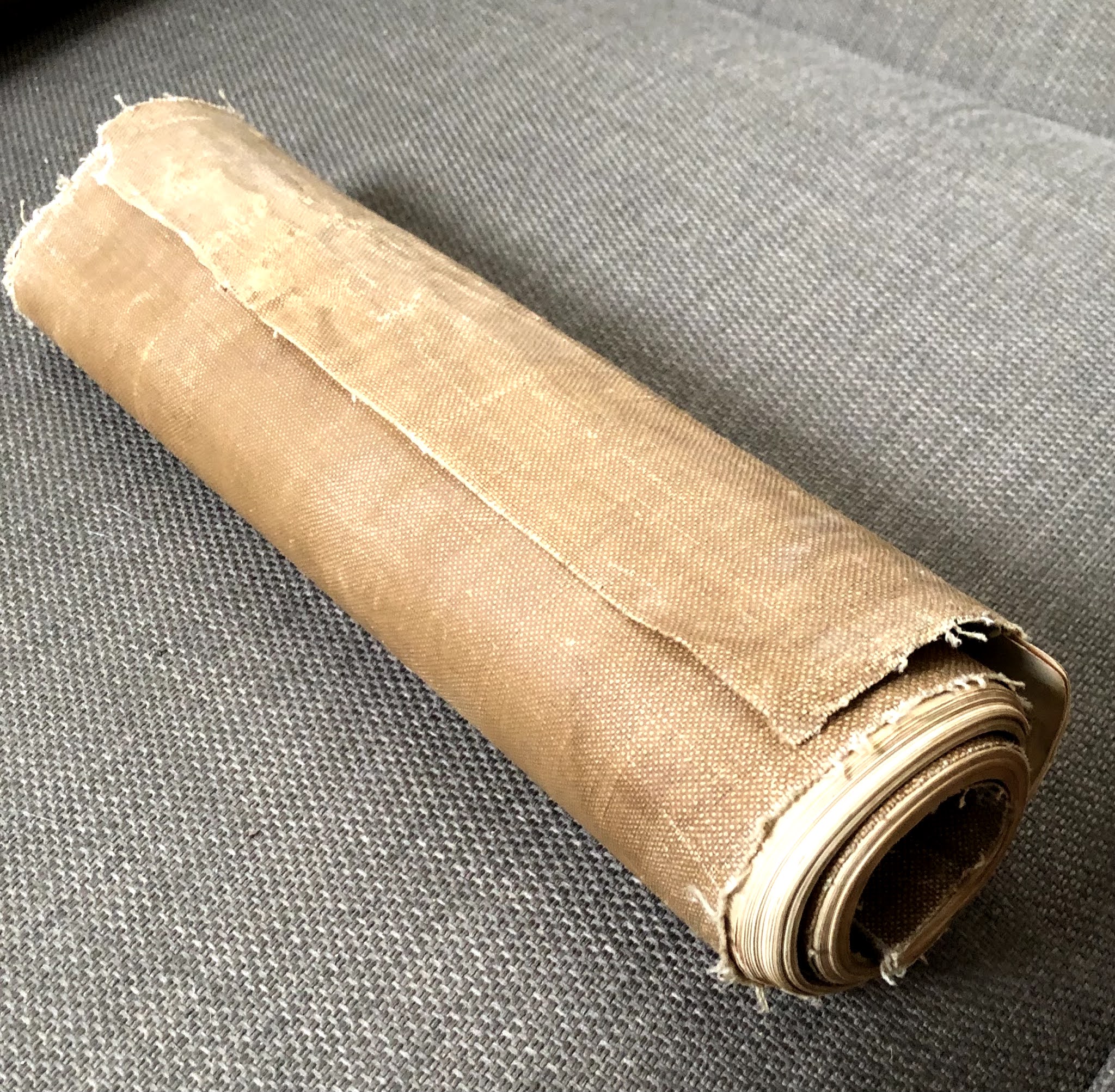
That’s the case with the book I am showing off here today. The book is an album of county maps for the state of Ohio, showing the state of the state’s roads and highways in 1910. Roads on each map are color coded: red for brick paving, orange for macadam, and blue for gravel. Probably it goes without saying, but a large number of Ohio’s roads in 1910 were none-of-the-above: unpaved dirt roads, presumably. 


[The road my dad lives on today, for what it’s worth, shows up on the relevant map in this atlas as just such a dirt road, which it still is now, 110 years later. He tells me, however, that soon it will be paved: and that’s infrastructure progress in Ohio.]


Anyway, this highway atlas is a codex, bound at the left edge; the first picture above shows the front cover, with printed text on very heavy brown cloth.


This picture, on the other hand, shows the book as it appeared when I purchased it:


1910 Highway Maps, as found.

As a rule, atlases and books of maps are like other books: condition matters, and one hopes to find each map flat and clean. The water damage visible on the front cover is not a pleasing feature, but the tight rolling-up of the book as a whole seems, at first glance, like a sad consequence of the books mistreatment and mis-storage across the last century or so.

1910 Highway Maps, showing
long extension of rear wrap.

But in fact, that's not the case. It seems (to me, at least) fairly clear that this copy of the book was issued to be rolled like this: the rear cover, made of the same cloth as the front, extends at least six inches beyond the edge of the text block, and this extension seems clearly intended to provide extra protection for the book when rolled. This sort of horizontal rolling make this printed codex at least a little bit like a scroll.


I have been unable to determine if all the published copies of this book were given the same treatment; it looks to me as if the extra cloth could easily be trimmed off, if one expects to store one's copy of the book flat. It would be a shame, I think, to flatten this one out, no matter how much that would ease the problem of storage.


It's a continuing surprise to me, when I find something I've not seen before--but it does still happen, once in a while. And so, surprise or not, I've come to expect that it will happen again.


Tuesday, October 20, 2020

King Alfred of Wessex Bookplate

Charles Fifield's Bookplate (ca. 1902).
The Corona-virus pandemic has recently virtualized two academic conferences I had hoped to attend next summer, the Medieval Congress in Kalamazoo (May 2021) and the International Medieval Congress in Leeds (July 2021). Of course it is true that the academic work of presenting papers (and attending papers as they are read) can still go on virtually, but I doubt I am alone in thinking that it's seeing old friends in person that's the true reward of going to a conference.

Had I gone, both of the papers I would have given would have at least touched on my old claim that King Alfred of Wessex (871-99) was a collector of books. So I was delighted, this week to come across this early twentieth-century bookplate that suggests much the same thing.

Located on the inside front board of a book from 1902, Charles L. Fifield's bookplate has a certain rustic charm, even if artistic appeal may not be its chief attraction. It may be the case that Fifield himself provided the drawing that the plate was made from. The little poem at the bottom of the plate says:

King Alfred, deep engrossed in book

  Forgot the cakes and let them burn

Remember Thou, the book thou took

  Ought to its owner soon return.

Of course, this refers to the legend of "Alfred and the Cakes," the most popular story ever told about Alfred: at his fortune's lowest ebb, he took refuge in a herdsman's cottage and was rebuked by the cottager's wife for allowing her cakes to burn when he ought to have been watching them. Almost certainly the story is apocryphal; it appears to suggest that Alfred as a "lord" of his people (Old English hlaf-weard = loaf-guard) had failed, and needed to be reminded of his duties: in the earliest records of the tales, it is not cakes that burn, but loaves (Latin: panis, breads). 

In most retellings of the story, Alfred is distracted by military worries about how to regain control of his kingdom, nearly overrun by the Danes; this bookplate's little poem is the first time that I can recall the suggestion that he was distracted by his reading.

Though some of my readers may recognize it, it may be worth explaining that the Old English phrase on the bookplate, "Alfred Mec heht gewyrcan" is the text on the Alfred Jewel, one of the great treasures surviving from late ninth-century England, often associated with Alfred's literary and book-producing activities.  

It's a delight to add this little homage to Alfred to my own collection of books, where it can also serve as a reminder, perhaps, for me to take an extra bit of care with my pandemic baking. 


Monday, October 12, 2020

Mini-Catalogue Monday 204: Leaves, Fragments, and Archives


One of the things I never quite imagined when I left academia for the word of selling rare (and not-so-rare) books was that I would come across material that can only be described as archives. In my case these have always still been small things (at least so far), nothing that can't fit in a single box, for example, even if sometimes it has been a fairly large box.

Of course, when I work with medieval fragments, I always commit to keeping fragments together whenever I can, and the same is true with this kind of archive: splitting things up that belong together just doesn't seem quite right.

Anyway, there's a handful of such lots or small archives in my newest little catalogue, number 204.  The one I want to talk about in this blog is one I was particular glad to find.

The archive itself is quite small, only five items. Two are books, and three are pieces of artwork. All are signed by the well known New Yorker cartoonist Ed Fisher, who is an especially interesting figure for me because of my interests in both medievalism and comics. The books are Ed Fisher's Domesday Book (1961) and Ed Fisher's First Folio (1959). Even the titles exhibit a kind of medievalism, and many of the cartoons inside them do as well.

But these are New Yorker cartoons, or at least ones in the New Yorker mode, so they always comment on contemporary matters as well. But I love the medievalism of this cartoon depicting a stained glass window--with air conditioner:


And the alien invader confronting the armored car in the following cartoon certainly makes some visual references to the medieval suit of armor:


But as much as I like those two cartoons, it is the depiction of the constellations over Times Square that I find most wonderful here. In this one, Fisher's reference in the past is perhaps the classical world, rather than the Middle Ages, but what an iconic cartoon for 1950s New York!

And that's the thing about archives, too: they are always a reminder that collections are more than the sum of their parts: the juxtaposition of past and present in these three cartoons is augmented, somehow, by their juxtaposition with one another. And that's why it seems important to keep them together.

Wednesday, October 7, 2020

Printed to look like script, 1708.

1708 Obligation bond,
in Latin and English

Naturally, when the printing press first appeared, the newly cut types were intended to look like letters. Since, until that time, manuscript letters were practically the only letters anyone knew, of course early printed books ended up looking visibly similar to manuscripts. 

On the obligation bond shown here, dating from 1708, the printed text is also intended to look like manuscript letters, but for a manifestly different reason. Here, the printed portion of the document is supposed to look like a manuscript, and--implicitly, at least--a typeset version (with more type-like letters) would not be as acceptable. 

Part-printed documents had made use of conventional typesetting for some time before this, at least in some contexts, but for one reason or another, the visual look and feel of this kind of document seems to have still benefitted from this script-like presentation. 

There are other observations we might make: it looks to me like there is a plate mark around the edge of the paper here, so it seems best to suggest that the printed portions of this bond were made from an engraving, rather than from a woodcut.


I'm not sure if it can be seen readily here, but each of the two men named Richard Thaier who seals this document (father and son), seems to use the very same seal, which features an anchor. 

It's just a simple document, but interesting, even so.

Saturday, October 3, 2020

A French document recycled as a pouch, pocket, or wallet

It's been a long time since I've posted anything here on the Chancery Hill Books blog: it's been a strange few months of Covid isolation, and while I've been (fortunately) able to find a few things to buy, I haven't had much motivation for writing.  But there's almost always something to share, even if it's small.

1629 French document on vellum.

The item I wanted to show today is a little French document, roughly eight inches by ten when folded. It is somewhat difficult to read because of aging, the translucence of the vellum, and the rapid French cursive documentary script of the time, but a later hand has at least given us the date: 13 mars 1629. Probably, this is an eighteenth-century hand; at the least, it probably indicates something about the date this document was recycled.

In form, this was originally a little single-fold booklet, four pages, with writing on all four. As it stands now, this is its current from, too: though an additional horizontal fold occurred at some point, almost at the half-way line, visible in the image only as a darker line at about the tenth line of writing. 

Documents like this must have been extraordinarily common in seventeenth-century France: they can only be described as common today, although this one is obviously very close to 400 years old. In the eighteenth and nineteenth centuries (perhaps with a peak after the Revolution) such vellum documents were frequently recycled in bookbindings, as wrappers or spine strips or covers for card boards.

The only evidence for the recycled use of this document however, is a series of small holes at the top and bottom margins of the document:

Note the pierced holes at bottom margins.

These holes go right across the top and bottom margins and across both leaves of this little bifold: at first glance, they might be mistaken for the pricking holes so often used to rule lines on vellum in medieval manuscripts. But, of course, the lines that could be ruled from these holes would be vertical here, rather than horizontal.

And these holes are not spaced particularly evenly, and they were certainly made after the sheet was folded: the simplest explanation is that these were sewing holes, and that this sheet was once sewn up to be used as a pouch or wallet, presumably to hold important papers or documents. 

Perhaps this says more about me than about such documents, but I find the evidence of recycling more fascinating here than the original document itself. 

Friday, May 8, 2020

Mini-Catalogue: Kalamazoo list

Five fragmentary bifolia.
This is the week where, in a normal year, I would be set up at the Medieval Congress in Kalamazoo, where medieval scholars annually meet in a free-for-all of conference papers, book-room purchases, and dancing. Well--not all the attenders participate in all three, and one suspects that many others would add drinking to the list of must-do activities. The plastic glasses of boxed wine are legendary.

This year, of course, the conference has been cancelled, and so I've put together a little catalogue of the items I've gathered during the past year that I would have otherwise been delighted to show off at Kalamazoo. It includes books on medieval texts and medieval topics from 1596 to 1773; binding fragments from early printed books and from even earlier manuscripts, and a handful of manuscript leaves cut and dispersed fifty or more years ago. 

Here's a link to the catalogue, for those who might want to look at it.

One of my favorite items is shown in the illustrations here: a group of incunabula leaves that were all used in a binding (or, possibly, a set of related bindings). Although they derive from at least four or five separate incunabula, their use together seems clear, and they may thus indicate the contents (or part of the contents) of a long-lost incunabula-period sammelband. 

Part of the colophon on one of the leaves above.
Note the date in the last line: Mccccxcviii

The detective work to identify the incunabula books that these leaves derive from was, as always, a lot of fun.  

Well, the results were fun, but like all detective work, those results came after a certain amount of tedious and repetitive labor. They all date from 1497 to about 1500, and they are all quite scarce, with only about 20 or so copies recorded in the online bibliographies of incunabula. To me, since they are before 1500, they are every bit as much "medieval" as manuscript fragments.

I got interested in binding fragments because of my interest in medieval manuscripts, but I've come to understand that these early printed binding fragments can be just as interesting, just as important, and they are--if anything--more fragile and at-risk than manuscript fragments. But as far as I know, the big projects of fragmentology that are ongoing pay little or no attention to such printed fragments. 

Medievalists, I hope, can learn to care as much about printed medieval books and fragments as they do about manuscript ones.


Friday, March 13, 2020

Looking for Toilet Paper? My Search for a Toilet Paper Almanac

Western Reserve Almanac for 1826,
from Painesville, OH. 
I was at a local grocery store today, where the shelves intended for rolls of toilet paper were empty. The urge to stockpile (I won't say hoard) toilet paper at a time of crisis seems to me like a strikingly 21st-century phenomenon: once upon a time, of course, there was no such thing as toilet paper, and still people managed. Many types of things, of course, were used for the purpose in the past, but this is a blog about books, and it's books I am writing about today. Specifically, the kinds of books that might once have been intended for the outhouse.

I am young enough—and I’ve lived in the right parts of the country—that I don’t think I’ve ever been required to use an honest-to-goodness outhouse. Some of the unimproved state parks I visited in my childhood had facilities that came close, but none were strictly outhouses in the old fashioned sense. 

The kind of outhouse I mean is a building—an outbuilding—that contains the most basic sort of hole-in-the-ground privy, and it’s a necessary adjunct to almost any house with no indoor plumbing, although the judicious use of chamber pots can also serve—as long as there is provision made for a place to empty them. For the most part, outhouses fell out of use in this country (the US, I mean) in the twentieth century, as wells with electric pumps allowed indoor plumbing in even the most rural homes, as long as (as I’ve heard it said) they “had the electric.” 

The comfort of American outhouses was surely improved in the late nineteenth century with the invention and widespread marketing of the humble toilet paper roll. There was no dedicated product for wiping one’s bottom before the 1850s, and for all the centuries of earlier time, other things must have been used. At least in this country, printed paper pages were often recycled in outhouses, and it became traditional for ephemeral printed almanacs, once their time of relevance had passed, to be used in outhouses (in the twentieth century, mail order catalogues were also often used). Perhaps this says more about me as a book collector than I should publicly reveal, but I recently set about trying to see if I could find such an old almanac—not one that had actually been used as toilet paper, but one that had narrowly escaped such a fate. 

Annual printed almanacs have been around for hundreds of years, and the direct ancestors of our modern almanacs can be found among the earliest printed books of the incunable period. Then and now, such books have been inherently ephemeral, and at the end of each year, they become largely useless and purposeless. As a result, some early almanacs are often quite rare today, precisely because there was no motive for keeping them.

How early it was that almanacs began to be used as toilet paper may not be easy to determine, however. The most popular traditional almanac these days (The Farmers’ Almanac, also often known as The Old Farmers’Almanac) has a pre-drilled hole in the upper left corner of the book, and their own website indicates that such holes have been drilled since 1919, precisely to allow the book to be hung from a nail, "in homes, barns, and outhouses." Many nineteenth-century almanacs I’ve encountered were bound with string, often leaving a loop in the upper corner, also presumably for hanging the book on a nail. But would it be possible for me to find an almanac that had actually been hung in an outhouse, or at least intended for such a purpose?

For years, I have been interested in the ways books and manuscripts have been recycled. The recycling of an almanac as toilet paper is surely among the lowest of such recyclings: we know that a book has become its most useless and least valued when it is put to use as toilet paper. I have been fortunate to have, in my own collection, some almanac or calendar scraps from the 1500s, recycled in later book-bindings, as also happened with some medieval manuscripts; the recycling of more recent books has a natural appeal to me, an extension of one of my own well-established collecting areas. That such recycling would have occurred tickles the side of me that enjoys the low scatological humor of Chaucer’s Miller’s and Summoner’s Tales.

A portion of a broadside calendar or almanac, recycled in a book-binding,
printed by Ioannes Schott, and tentatively dated to 1503.
Note the notices of eclipses, at left and right hand sides here.

But the question has been, of course, how could one ever know about a use intended for a recycled almanac that was never put into practice? The most obvious sorts of evidence are ambiguous at best. If an almanac was to be hung in the outhouse by a loop of string in the binding, it was just as likely to have been hung on a nail or hook in a home or cabin. If pages could be ripped out to be used as individual sheets of outhouse paper, it is equally true that old almanacs might suffer similar losses for many other reasons. Experience will quickly show that many old almanacs are today incomplete, with missing pages and often with missing covers (if they had covers in the first place). Neither a hanging loop nor the loss of pages can really make the case fully.

1828 Western Farmer's Almanac, string bound with
the 1826 Western Reserve Almanac. Not that the 1826
book is incomplete at the end.
But I think that all hope is not lost. The most ephemeral of nineteenth-century American almanacs (and earlier ones as well), were small objects, roughly four inches by seven, and often only 24 or 48 pages in length. One guesses that when such a book was finally hung on an outhouse peg, its remaining useful life was not very long. Once in a while, however, you can find a group of almanacs from different years that have been sewn together, often with pages missing. One reason to sew almanacs together, it would seem, would be to preserve them for the future: since many almanacs had owners’ notes of one sort or another within them, there might be a motive for keeping them, and for keeping them together. But when pages are missing, it’s easy to imagine that either the preservation motive did not last long, or that there was another motive from the start. It is at least possible, of course, that several old almanacs would be sewn together so that there would be a larger supply of pages all on one loop or one nail. 

Close-up of the stab-sewn binding of the Western Farmer's Almanac,
with the hanging loop. The darker/black thread binds
the two books together.
It is probably impossible to be certain if any single almanac or sewn-together group had truly been intended, by a past owner, for the outhouse nail. But when we find almanacs from various years sewn together, with pages missing from some or all of them, I think we have the best candidates for such almanacs that we are likely to find. And a knowledge of the contents of most old almanacs might give us an additional clue. The usual form of an almanac includes a month-by-month calendar at the beginning, usually taking up twelve pages; the rest of the book often included reading or reference material. The reading material might be humorous, didactic, topical, or political, but the key point here is that the calendar section was, perhaps, the section most likely to go completely out of date. If the missing pages from a string-bound collection of almanacs are concentrated in the calendar sections, then we might guess that the less ephemeral sections were being preserved for bathroom reading, and the calendar pages being used up first.

1839 Temperance Almanac,
one of six almanacs from 1839 to
1845, roughly bound together. 
In the end, I have been able to find a couple examples of such collections. They are a powerful reminder of how literally it can sometimes be said that one person’s trash in another one’s treasure. They remind us of how lowly some books have been valued, with some being tossed, page by soiled page, into the cess-pit. And other books, equally little valued may have only narrowly avoided such an end.

All truly ephemeral books are strange survivals, if they survive at all. By definition, ephemeral materials go out of date, and—at least for a time—there is no clear reason to keep or preserve them. The typical fate of the ephemeral is thus always loss or destruction. Almanacs, however seem to have long been understood as having had an especially typical or common secondary use as outhouse supplies, destined for the pit. Other than fire itself, I can think of no more metaphorically hellish (or perhaps merely Chaucerian) fate for a book, although until the invention of dedicated toilet paper, that fate must have found literally millions of old almanacs. If being treasured in a library or collection is, by contrast, a kind of heavenly afterlife for an ephemeral book, I am fascinated by the tantalizing possibility that some of the old almanacs I’ve collected might have stood at the brink of both such fates in their time.

It is one thing, I think, to collect what everyone knows is valuable: when a collector or a library pays hundreds or thousands of dollars for a book, they do so (almost always) because the book in question has long been safe from the pit, and is now merely passing from one treasured collection to another. But to pull a book from the brink, that’s something else entirely, and it can only be done, I think, by collecting the most humble and (almost) useless of books.

From the 1839-1845 bound volume.

1844 Almanac from the same volume, lacking title page;
see torn stub at top center.


Wednesday, December 4, 2019

A Book Curse that Curses the Book, ca. 1899

It's the holiday season around these parts, and for various reasons, I haven't been very busy writing blog posts. But today, I thought I'd share a book I've had for the better part of two decades: not a new acquisition by any means.

But the story I will tell here is not just about a book. It is also about something else that has intrigued me recently: the unbelievable power of internet searching for letting us find the pieces of an otherwise lost or unknown story. Internet searches, I've started to think, can sometimes offer incomparable moments of serendipity, if only we can manage to connect what begs to be connected.

But to return to the topic with which I began:

Reed & Kellogg's Higher Lessons
in English
(1892)
Back when I was living in Colorado, I frequently found myself teaching a class which included sentence diagramming as part of its content. So when I ran across this 1892 copy of Higher Lessons in English, by Alonzo Reed and Brainerd Kellogg, I had to have it. It is a book that uses so-called "Reed-Kellogg" diagrams, familiar from my own elementary school days, with clauses laid out on horizontal lines, with subjects and predicates separated by a vertical bar, and with modifiers slanting down from the words they modify. And these were the very type of sentence diagrams I was teaching my college-level students. And I still think that maybe there's a place for this mode of grammatical analysis.

I stopped teaching such diagrams years ago, but I've held onto the book because it's one of the few books I've had that has an honest-to-goodness book curse in it. And it has not one, but two!

Book curses, if any of my readers have not encountered them, are inscriptions by owners that are intended to make sure that books are not stolen away by readers or borrowers. They are highly traditional, going back at least to the middle ages, and one of the curses in this book has all the markings of coming from a real tradition:

Ed Cassedy's Curses; the bottom four lines
probably composed and written before
the top five.

Don't steal this book for fear of shame
For here you see the owners name
He will chase and catch you too
And then will beat you black and blue
       Ed Cassedy

A quick internet search on the phrase "steal this book for fear of shame" will, indeed, turn up references to a number of similar book curses, though usually (or always) consisting of something like the first two lines alone. The final two lines are probably Ed Cassedy's own composition.

A later page in the book suggests that Ed Cassedy (he signs in full as "Edwin Gray Cassedy") used the book while he was in the eighth grade in 1899; apparently the book had been handed down from his sister, Carrie C Cassedy, from Canon County [Colorado], who signed the book on September 2, 1893, when it was probably new. 

[Sidebar: As I was composing this little blog post, I was unsure of the spelling of Ed's name, given the impreciseness of pencil script and his own inconsistency in dotting the letter "i"; my internet search for "Edwin Gray Cassidy" turned up exactly one link, to an oral history interview with  Pittsburgh-born artist Sue Fuller, and I happily send my readers down that particular rabbit hole, because it seems clear that Sue Fuller is, indeed, talking about the same guy, her uncle. But probably, you should also make your own search for "Edwin Gray Cassedy," which will allow you to trace at least part of the later life of the author of my book curse. Like Sue Fuller, Ed Cassedy also turned out to be an artist.]

Anyhow, the eighth-grade Ed Cassedy seems to have reconsidered the reasonableness of cursing the borrower or thief who might take the book from him, writing the following couplet above the four line poem already quoted:

Dont steal this
book and \then/ bring it
back but stick it
in the stove and
burn it black.

In this little addendum, Ed Cassedy prays that any thief or borrower destroy the book, rather than return it. The curse is no longer aimed at the book thief, but at the book. I suppose that many schoolchildren, over the years, have similarly hoped to be spared the tyranny of their books, but I don't recall seeing a purselike this one before, and I find it both clever and charming, in a kind of rough-and-tumble Wild West way. 

This book is a humble, humble book. But somehow, in the completely unpretentious additions that Ed Cassedy made to what started out as a traditional book curse, something remarkable happened. Not every little verse--or curse--that makes it into a book transforms it so marvelously  I think, nor does every internet search I perform turn up things as interesting as the searches I've pointed my readers to here. 

But some of them do.