Wednesday, January 3, 2024
Etrennes: A New Post for a New Year
Monday, October 11, 2021
Ohioana and Pennsylvaniana: Catalogue 213
It's been a while since I've posted anything at all on the Chancery Hill Books blog--I've been busy with one project and another, and enjoying the summer on top of all that. But now it's turned to fall, and I've finally got another little catalogue ready.
Everything in this one is from Pennsylvania or Ohio, and there's everything from children's chapbooks to historical accounts of W.m. Tecumseh Sherman, to a rare book of poems from the American Centennial possibly given away by one of the Shermans (William Tecumseh, or his political brother, John, both from Lancaster, Oh):
![]() |
| Wm. P. Moone's National Songs. |
Here's the inscription on the back of this book, mentioning "Mr Sherman":
Obviously, the rear cover of the book is quite damaged, but given the location of the inscription, it's possible to guess that the cover has been torn since at least 1881.
I can't say Moone is a great poet, but this book is rare: the WorldCat entry appears to record only an electronic "Internet Archive" copy, with no clear examples of surviving paper copies--although the electronic facsimile shows stamps on the original indicating it came from the Library of Congress. One hopes that is is still there, despite the WorldCat record.
There's plenty of other things in the catalogue, too: here's the link:
Wednesday, April 21, 2021
Hezekiah Burhans's Octonisyllables.
![]() |
| Title page of Burhans's 1821 spelling book. |
At the antique auctions I sometimes attend, books and other items are often grouped and sold by the boxful. Bidders, each with their own unique knowledge base, may have a clear sense of the value of only some of the items in any particular box, and when the bidding starts, there's every chance that different bidders are bidding on different items in the same box. The result is that sometimes a buyer like me ends up with something wonderful that they didn't even know they were buying.
My post today is about one such "come-with" from the auction I went to last week. It came in a box of books that I was buying for other reasons (chiefly, I was trying to secure the rare Rough and Ready Primer from ca. 1849 that I had seen in the box).
So I ended up with a copy of Hezekiah Burhans's 1821 Critical Pronouncing Spelling-Book completely by chance. The book, as a quick check on WorldCat suggests, was issued in several editions during the 1820s, and Burhans was especially concerned to provide a work that would be suitable for both British and American audiences. In this, Burhans may have been working against the tide of Americanization promoted by figures such as Noah Webster, and it may not have helped his case that his works were often self-published.
But Burhans's book was nevertheless ambitious, and (among various other things) he attempted to communicate clearly how stress levels operated in the pronunciations of long multi-syllabic words. Without going into too much detail of his system, I thought I would at least share with readers of the blog Burhans's unique names for the various multi-syllables.
![]() |
| Burhans's table of word lengths |
Here we see a couple of familiar terms, but Quinisyllables, Senisyllables, and Octonisyllables were all new to me. I was a bit surprised to find that Google searches on each term turned up no results at all. Likewise, searches for these terms in Google's Ngram viewer also turned up no results.
So very often I've used Google to help me identify the text on a manuscript or printed fragment, I have come to unthinkingly rely on it as usefully complete. But of course Google books has certainly not digitally stored all books, and even if one copy or another of Burhans's book may have been scanned by Google, these words still have not turned up. (It may be worth noting that OCLC/WorldCat appears to record only three copies of this 1821 first edition in institutional libraries).
![]() |
| The pronunciation of Septisyllables and Octonisyllables |
It seems likely that Burhans invented these terms. Google's Ngram viewer confirms, for example, that octosyllable was in use before 1800, and we know that Burhans's new coinages never caught on, as his system itself perhaps never really caught on. But it seems a fascinating "might have been."
![]() |
| Monosyllables |
This was a book I've never encountered before, and probably I'll never encounter it again. There may be copies safely held in a few libraries, but few people, I suspect, have ever looked for them. And yet there is something of interest here. Serendipity: when you find something you were never looking for.
Wednesday, January 20, 2021
An Engraved Book: Fleur de Myrte, [1821]
![]() |
| Fleur de Myrte (Paris: Janet, 1821) |
And when I say "a little book," I truly mean a little book, as it measures about 3 7/8" tall.
It is an example of a particular kind of book that I can't seem to stop myself from buying now and then: the almanac. In particular, it's one of a fairly extensive group of French almanacs from roughly the 1810s to the 1830s. They take the generic name of almanacs because they almost always have a little calendar included, but really they are little gift books, often aimed at an audience of girls or women, and they usually have French poetry as the bulk of the content. Like this one, they generally seem to have been issued in matching slipcases. They must have been aimed at the aspiring classes: filled with poetry, and available at a variety of price points: the present example is cheaply bound, but fine binding options seem to have been available, including leather, hand-painted silk bindings, and even the occasional binding in glass.
![]() |
| Bound in green card covers with matching slipcase or etui. |
In short, French almanacs of the period are tiny, cute, sweet, and can be found in a variety of bindings and treatments, and they are often at least somewhat rare. What's not to love about them?
Rare, of course, is a relative term. But these books, naturally enough, often seem to have been treated as ephemeral by their original owners, and many titles are fairly rare on the market these days. This particular little book, titled "Fleur de Myrte" doesn't seem to be available online at all (neither on ABEbooks nor on Addall), and only two copies are reported in institutional collections on OCLC/WorldCat: one at the Bibliotheque Nationale in Paris, and one at Yale.
![]() |
| First half of 1822 calendar tipped in before title. |
WorldCat does not give a definite date; Yale estimates the date as "181-?" My copy must have been offered for sale in 1821 or 1822: there is a calendar present (six months at the front cover, and six months at the rear) and the calendar is for 1822. Presumably, the book might have been printed up some years earlier, and calendars added as needed; notably the Yale copy does not seem to record the presence of a calendar at all.
And the book, as noted above, is interesting in one other way, too: not only the title page, but all of the text pages of Fleur de Myrte are entirely engraved, and some are faced by engraved illustrations. Note that here, on the right hand page, the punctuation at the end of the second poetic line goes beyond the bounding line: impossible, really, if typeset, but no problem for an engraver!
![]() |
| Engraved illustration page and engraved text page. |
I am always astonished when I buy a book which turns out to be held in so few major libraries across the world. (And I'm even more surprised when it happens that I get a printed book recorded in no libraries in WorldCat.) And that's one of the fun things about being a bookseller: here, with this little book, I can help pin down the date of publication for a book--it's not a major addition to our knowledge of French literature, but when Yale and the Bibliotheque Nationale don't know the date, it's a useful crumb of knowledge to contribute, even so.
Sunday, November 29, 2020
A failure to follow directions
![]() |
| Missal leaf, with mistakes. |
In the case of the small missal or breviary leaf to the left (the whole leaf measures only about 5 3/4" by 3 1/4"), at least two errors can easily be seen.
The more obvious one involves the red (i.e., rubricated) text written into the lower margin. It is, as one might be able to see, preceded by a little red caret; the matching sign can be found in line 18 of the first column, just to the left of the two-line red "n" in the right hand column. As I hope is obvious, the position of the matching sign indicates where the added passage belongs.
Very possibly, this was a mistake by the primary scribe; at the least it seems to have been corrected by a second scribe, who uses a single-compartment a, rather than the main scribe's regular, two-compartment a. It is notable that this correction has been written on a couple of added ruling lines, provided just for this passage.
The second error, however, is clearly made by the rubricator.
Although they may be difficult to see on the full-page image of this page, guide letters survive in the right-hand margin of this page: q, n, and n. The first two were no trouble for the rubricator, but something went wrong with the third:
![]() |
| Closer view of rubrication error and correction. |
I find it strangely comforting to know that my own failures, at times, to follow directions are nothing new in the world, and even medieval scribes and rubricators had their off days.
Tuesday, October 27, 2020
A Codex-Scroll? 1910 Ohio Highway Atlas
![]() |
| 1910 Highway Maps of Ohio. |
During the long span of this history, there seems to have been endless experimentation with the basics of the codex form, and although I’ve been interested in physical books and book history for some time, every now and then I am still delighted to come across a book in a format that I’ve never seen before.
That’s the case with the book I am showing off here today. The book is an album of county maps for the state of Ohio, showing the state of the state’s roads and highways in 1910. Roads on each map are color coded: red for brick paving, orange for macadam, and blue for gravel. Probably it goes without saying, but a large number of Ohio’s roads in 1910 were none-of-the-above: unpaved dirt roads, presumably.
[The road my dad lives on today, for what it’s worth, shows up on the relevant map in this atlas as just such a dirt road, which it still is now, 110 years later. He tells me, however, that soon it will be paved: and that’s infrastructure progress in Ohio.]
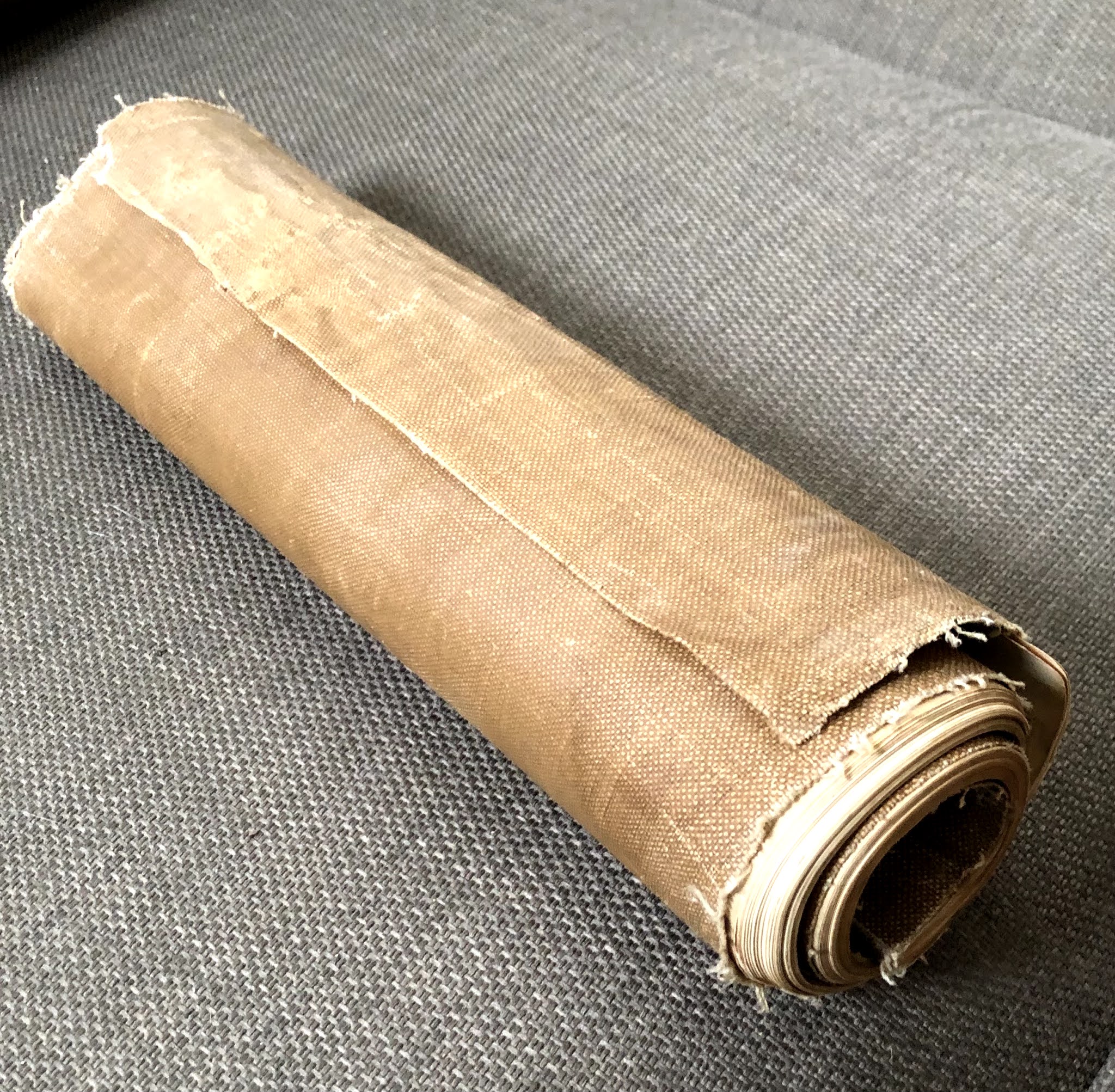
Anyway, this highway atlas is a codex, bound at the left edge; the first picture above shows the front cover, with printed text on very heavy brown cloth.
This picture, on the other hand, shows the book as it appeared when I purchased it:
![]() |
| 1910 Highway Maps, as found. |
As a rule, atlases and books of maps are like other books: condition matters, and one hopes to find each map flat and clean. The water damage visible on the front cover is not a pleasing feature, but the tight rolling-up of the book as a whole seems, at first glance, like a sad consequence of the books mistreatment and mis-storage across the last century or so.
![]() |
| 1910 Highway Maps, showing long extension of rear wrap. |
But in fact, that's not the case. It seems (to me, at least) fairly clear that this copy of the book was issued to be rolled like this: the rear cover, made of the same cloth as the front, extends at least six inches beyond the edge of the text block, and this extension seems clearly intended to provide extra protection for the book when rolled. This sort of horizontal rolling make this printed codex at least a little bit like a scroll.
I have been unable to determine if all the published copies of this book were given the same treatment; it looks to me as if the extra cloth could easily be trimmed off, if one expects to store one's copy of the book flat. It would be a shame, I think, to flatten this one out, no matter how much that would ease the problem of storage.
It's a continuing surprise to me, when I find something I've not seen before--but it does still happen, once in a while. And so, surprise or not, I've come to expect that it will happen again.
Tuesday, October 20, 2020
King Alfred of Wessex Bookplate
![]() |
| Charles Fifield's Bookplate (ca. 1902). |
Had I gone, both of the papers I would have given would have at least touched on my old claim that King Alfred of Wessex (871-99) was a collector of books. So I was delighted, this week to come across this early twentieth-century bookplate that suggests much the same thing.
Located on the inside front board of a book from 1902, Charles L. Fifield's bookplate has a certain rustic charm, even if artistic appeal may not be its chief attraction. It may be the case that Fifield himself provided the drawing that the plate was made from. The little poem at the bottom of the plate says:
King Alfred, deep engrossed in book
Forgot the cakes and let them burn
Remember Thou, the book thou took
Ought to its owner soon return.
Of course, this refers to the legend of "Alfred and the Cakes," the most popular story ever told about Alfred: at his fortune's lowest ebb, he took refuge in a herdsman's cottage and was rebuked by the cottager's wife for allowing her cakes to burn when he ought to have been watching them. Almost certainly the story is apocryphal; it appears to suggest that Alfred as a "lord" of his people (Old English hlaf-weard = loaf-guard) had failed, and needed to be reminded of his duties: in the earliest records of the tales, it is not cakes that burn, but loaves (Latin: panis, breads).
In most retellings of the story, Alfred is distracted by military worries about how to regain control of his kingdom, nearly overrun by the Danes; this bookplate's little poem is the first time that I can recall the suggestion that he was distracted by his reading.
Though some of my readers may recognize it, it may be worth explaining that the Old English phrase on the bookplate, "Alfred Mec heht gewyrcan" is the text on the Alfred Jewel, one of the great treasures surviving from late ninth-century England, often associated with Alfred's literary and book-producing activities.
It's a delight to add this little homage to Alfred to my own collection of books, where it can also serve as a reminder, perhaps, for me to take an extra bit of care with my pandemic baking.