Showing posts with label Shelfie Wednesday. Show all posts

Wednesday, January 3, 2024

Etrennes: A New Post for a New Year

Perhaps it is a fool's errand to think that I might turn over a new leaf (a leaf of a book, naturally) and post a bit more frequently in the new year. So here's a little item from my collection, one of those occasions where a single book fits into more than one of my personal collections.
The collections in question are almanacs, a category of collecting that has not been something I intentionally set out to collect, but I've happened to get enough interesting examples that I have had to admit it's a collection. And since the French Etrennes refers to the New Year, it seemed appropriate to show this one off today. Titled Etrennes du Moment ou Almanach des Sans-Culottes (and dated 1793), it is a wonderful artifact from the early years of the French Revolution. I say "scarce": WorldCat seems to show only a handful of copies of this title in institutional collections, and all of them have a Paris imprint. The entries in Grand-Carteret's bibliography also seem to all be Paris editions; the present copy, from Annonay, may well be from an unrecorded edition.


Although it has been damaged by water and has its losses, I also love this book for its use of printer's waste in the binding, another one of my collecting areas. With some difficulty, one can trace this waste to a scarce publication by the printer of the almanac; it seems likely then, that this is the original binding as it left the printer's shop. 

Both humble, unusual, and a survivor: as I hope we all might manage the same after the passing of another year. 

Wednesday, January 20, 2021

An Engraved Book: Fleur de Myrte, [1821]

Fleur de Myrte
(Paris: Janet, 1821)


In a previous post, I showed a document printed to look like a manuscript; this post will look at a little book I came across recently the bulk of which was printed entirely from engraved plates, without type.

And when I say "a little book," I truly mean a little book, as it measures about 3 7/8" tall. 

It is an example of a particular kind of book that I can't seem to stop myself from buying now and then: the almanac. In particular, it's one of a fairly extensive group of French almanacs from roughly the 1810s to the 1830s. They take the generic name of almanacs because they almost always have a little calendar included, but really they are little gift books, often aimed at an audience of girls or women, and they usually have French poetry as the bulk of the content. Like this one, they generally seem to have been issued in matching slipcases. They must have been aimed at the aspiring classes: filled with poetry, and available at a variety of price points: the present example is cheaply bound, but fine binding options seem to have been available, including leather, hand-painted silk bindings, and even the occasional binding in glass.

Bound in green card covers
with matching slipcase or etui.

In short, French almanacs of the period are tiny, cute, sweet, and can be found in a variety of bindings and treatments, and they are often at least somewhat rare. What's not to love about them?

Rare, of course, is a relative term. But these books, naturally enough, often seem to have been treated as ephemeral by their original owners, and many titles are fairly rare on the market these days. This particular little book, titled "Fleur de Myrte" doesn't seem to be available online at all (neither on ABEbooks nor on Addall), and only two copies are reported in institutional collections on OCLC/WorldCat: one at the Bibliotheque Nationale in Paris, and one at Yale.

First half of 1822 calendar tipped in before title.

WorldCat does not give a definite date; Yale estimates the date as "181-?" My copy must have been offered for sale in 1821 or 1822: there is a calendar present (six months at the front cover, and six months at the rear) and the calendar is for 1822. Presumably, the book might have been printed up some years earlier, and calendars added as needed; notably the Yale copy does not seem to record the presence of a calendar at all.

And the book, as noted above, is interesting in one other way, too: not only the title page, but all of the text pages of Fleur de Myrte are entirely engraved, and some are faced by engraved illustrations. Note that here, on the right hand page, the punctuation at the end of the second poetic line goes beyond the bounding line: impossible, really, if typeset, but no problem for an engraver!

Engraved illustration page and engraved text page.

I am always astonished when I buy a book which turns out to be held in so few major libraries across the world. (And I'm even more surprised when it happens that I get a printed book recorded in no libraries in WorldCat.) And that's one of the fun things about being a bookseller: here, with this little book, I can help pin down the date of publication for a book--it's not a major addition to our knowledge of French literature, but when Yale and the Bibliotheque Nationale don't know the date, it's a useful crumb of knowledge to contribute, even so. 


Tuesday, October 27, 2020

A Codex-Scroll? 1910 Ohio Highway Atlas

1910 Highway Maps of Ohio.
Books have been around for a very long time.  Codexes—by which I mean books made up of more than one leaf, bound together along one edge—have been around nearly as long, with single-fold examples surviving from Vindolanda, from the first or second century. Other multi-leave examples were preserved in Herculaneum by the eruption of Vesuvius in 79. 

During the long span of this history, there seems to have been endless experimentation with the basics of the codex form, and although I’ve been interested in physical books and book history for some time, every now and then I am still delighted to come across a book in a format that I’ve never seen before.


That’s the case with the book I am showing off here today. The book is an album of county maps for the state of Ohio, showing the state of the state’s roads and highways in 1910. Roads on each map are color coded: red for brick paving, orange for macadam, and blue for gravel. Probably it goes without saying, but a large number of Ohio’s roads in 1910 were none-of-the-above: unpaved dirt roads, presumably. 


[The road my dad lives on today, for what it’s worth, shows up on the relevant map in this atlas as just such a dirt road, which it still is now, 110 years later. He tells me, however, that soon it will be paved: and that’s infrastructure progress in Ohio.]


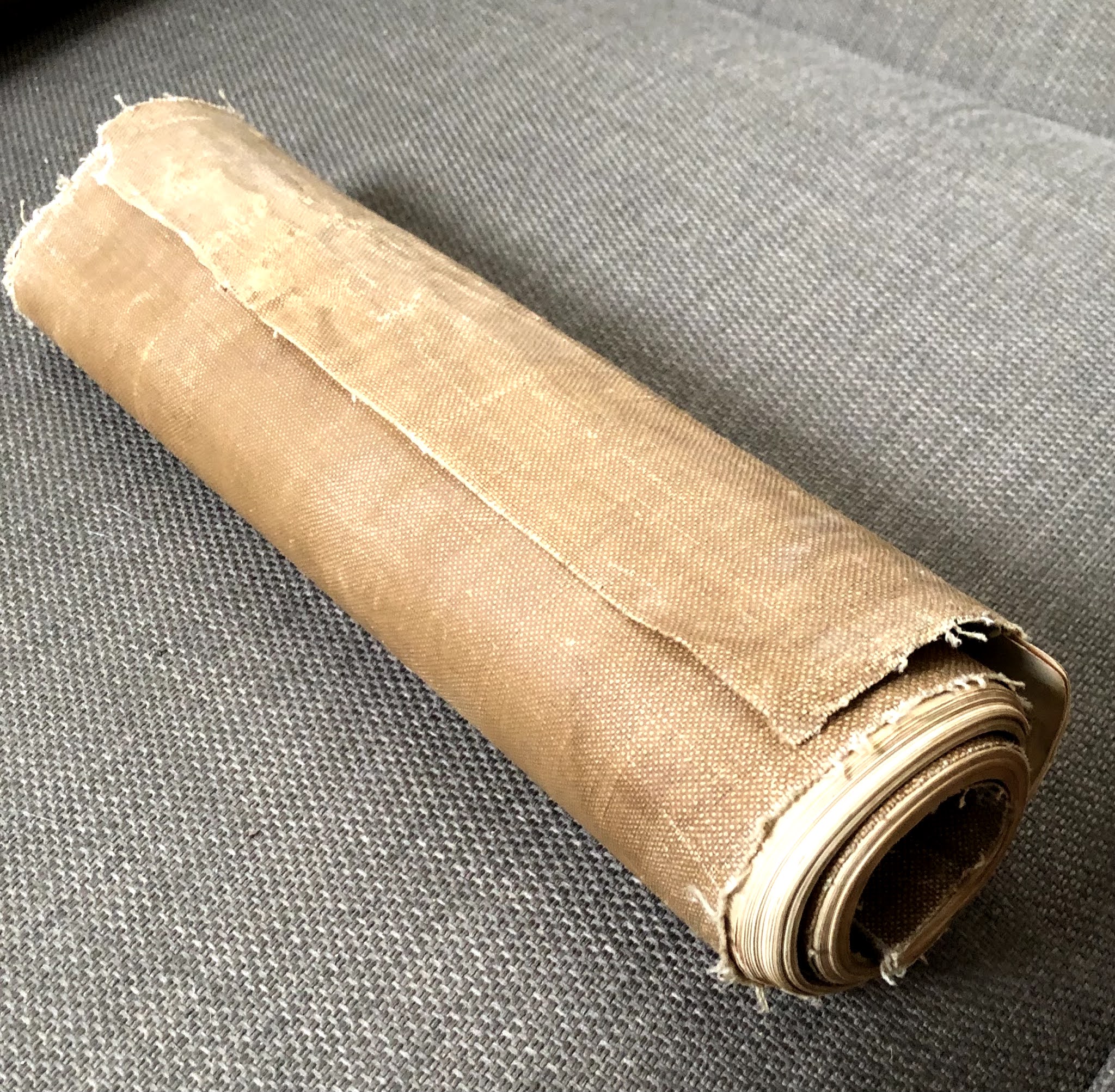
Anyway, this highway atlas is a codex, bound at the left edge; the first picture above shows the front cover, with printed text on very heavy brown cloth.


This picture, on the other hand, shows the book as it appeared when I purchased it:


1910 Highway Maps, as found.

As a rule, atlases and books of maps are like other books: condition matters, and one hopes to find each map flat and clean. The water damage visible on the front cover is not a pleasing feature, but the tight rolling-up of the book as a whole seems, at first glance, like a sad consequence of the books mistreatment and mis-storage across the last century or so.

1910 Highway Maps, showing
long extension of rear wrap.

But in fact, that's not the case. It seems (to me, at least) fairly clear that this copy of the book was issued to be rolled like this: the rear cover, made of the same cloth as the front, extends at least six inches beyond the edge of the text block, and this extension seems clearly intended to provide extra protection for the book when rolled. This sort of horizontal rolling make this printed codex at least a little bit like a scroll.


I have been unable to determine if all the published copies of this book were given the same treatment; it looks to me as if the extra cloth could easily be trimmed off, if one expects to store one's copy of the book flat. It would be a shame, I think, to flatten this one out, no matter how much that would ease the problem of storage.


It's a continuing surprise to me, when I find something I've not seen before--but it does still happen, once in a while. And so, surprise or not, I've come to expect that it will happen again.


Tuesday, October 20, 2020

King Alfred of Wessex Bookplate

Charles Fifield's Bookplate (ca. 1902).
The Corona-virus pandemic has recently virtualized two academic conferences I had hoped to attend next summer, the Medieval Congress in Kalamazoo (May 2021) and the International Medieval Congress in Leeds (July 2021). Of course it is true that the academic work of presenting papers (and attending papers as they are read) can still go on virtually, but I doubt I am alone in thinking that it's seeing old friends in person that's the true reward of going to a conference.

Had I gone, both of the papers I would have given would have at least touched on my old claim that King Alfred of Wessex (871-99) was a collector of books. So I was delighted, this week to come across this early twentieth-century bookplate that suggests much the same thing.

Located on the inside front board of a book from 1902, Charles L. Fifield's bookplate has a certain rustic charm, even if artistic appeal may not be its chief attraction. It may be the case that Fifield himself provided the drawing that the plate was made from. The little poem at the bottom of the plate says:

King Alfred, deep engrossed in book

  Forgot the cakes and let them burn

Remember Thou, the book thou took

  Ought to its owner soon return.

Of course, this refers to the legend of "Alfred and the Cakes," the most popular story ever told about Alfred: at his fortune's lowest ebb, he took refuge in a herdsman's cottage and was rebuked by the cottager's wife for allowing her cakes to burn when he ought to have been watching them. Almost certainly the story is apocryphal; it appears to suggest that Alfred as a "lord" of his people (Old English hlaf-weard = loaf-guard) had failed, and needed to be reminded of his duties: in the earliest records of the tales, it is not cakes that burn, but loaves (Latin: panis, breads). 

In most retellings of the story, Alfred is distracted by military worries about how to regain control of his kingdom, nearly overrun by the Danes; this bookplate's little poem is the first time that I can recall the suggestion that he was distracted by his reading.

Though some of my readers may recognize it, it may be worth explaining that the Old English phrase on the bookplate, "Alfred Mec heht gewyrcan" is the text on the Alfred Jewel, one of the great treasures surviving from late ninth-century England, often associated with Alfred's literary and book-producing activities.  

It's a delight to add this little homage to Alfred to my own collection of books, where it can also serve as a reminder, perhaps, for me to take an extra bit of care with my pandemic baking. 


Wednesday, October 7, 2020

Printed to look like script, 1708.

1708 Obligation bond,
in Latin and English

Naturally, when the printing press first appeared, the newly cut types were intended to look like letters. Since, until that time, manuscript letters were practically the only letters anyone knew, of course early printed books ended up looking visibly similar to manuscripts. 

On the obligation bond shown here, dating from 1708, the printed text is also intended to look like manuscript letters, but for a manifestly different reason. Here, the printed portion of the document is supposed to look like a manuscript, and--implicitly, at least--a typeset version (with more type-like letters) would not be as acceptable. 

Part-printed documents had made use of conventional typesetting for some time before this, at least in some contexts, but for one reason or another, the visual look and feel of this kind of document seems to have still benefitted from this script-like presentation. 

There are other observations we might make: it looks to me like there is a plate mark around the edge of the paper here, so it seems best to suggest that the printed portions of this bond were made from an engraving, rather than from a woodcut.


I'm not sure if it can be seen readily here, but each of the two men named Richard Thaier who seals this document (father and son), seems to use the very same seal, which features an anchor. 

It's just a simple document, but interesting, even so.

Saturday, October 3, 2020

A French document recycled as a pouch, pocket, or wallet

It's been a long time since I've posted anything here on the Chancery Hill Books blog: it's been a strange few months of Covid isolation, and while I've been (fortunately) able to find a few things to buy, I haven't had much motivation for writing.  But there's almost always something to share, even if it's small.

1629 French document on vellum.

The item I wanted to show today is a little French document, roughly eight inches by ten when folded. It is somewhat difficult to read because of aging, the translucence of the vellum, and the rapid French cursive documentary script of the time, but a later hand has at least given us the date: 13 mars 1629. Probably, this is an eighteenth-century hand; at the least, it probably indicates something about the date this document was recycled.

In form, this was originally a little single-fold booklet, four pages, with writing on all four. As it stands now, this is its current from, too: though an additional horizontal fold occurred at some point, almost at the half-way line, visible in the image only as a darker line at about the tenth line of writing. 

Documents like this must have been extraordinarily common in seventeenth-century France: they can only be described as common today, although this one is obviously very close to 400 years old. In the eighteenth and nineteenth centuries (perhaps with a peak after the Revolution) such vellum documents were frequently recycled in bookbindings, as wrappers or spine strips or covers for card boards.

The only evidence for the recycled use of this document however, is a series of small holes at the top and bottom margins of the document:

Note the pierced holes at bottom margins.

These holes go right across the top and bottom margins and across both leaves of this little bifold: at first glance, they might be mistaken for the pricking holes so often used to rule lines on vellum in medieval manuscripts. But, of course, the lines that could be ruled from these holes would be vertical here, rather than horizontal.

And these holes are not spaced particularly evenly, and they were certainly made after the sheet was folded: the simplest explanation is that these were sewing holes, and that this sheet was once sewn up to be used as a pouch or wallet, presumably to hold important papers or documents. 

Perhaps this says more about me than about such documents, but I find the evidence of recycling more fascinating here than the original document itself. 

Wednesday, December 4, 2019

A Book Curse that Curses the Book, ca. 1899

It's the holiday season around these parts, and for various reasons, I haven't been very busy writing blog posts. But today, I thought I'd share a book I've had for the better part of two decades: not a new acquisition by any means.

But the story I will tell here is not just about a book. It is also about something else that has intrigued me recently: the unbelievable power of internet searching for letting us find the pieces of an otherwise lost or unknown story. Internet searches, I've started to think, can sometimes offer incomparable moments of serendipity, if only we can manage to connect what begs to be connected.

But to return to the topic with which I began:

Reed & Kellogg's Higher Lessons
in English
(1892)
Back when I was living in Colorado, I frequently found myself teaching a class which included sentence diagramming as part of its content. So when I ran across this 1892 copy of Higher Lessons in English, by Alonzo Reed and Brainerd Kellogg, I had to have it. It is a book that uses so-called "Reed-Kellogg" diagrams, familiar from my own elementary school days, with clauses laid out on horizontal lines, with subjects and predicates separated by a vertical bar, and with modifiers slanting down from the words they modify. And these were the very type of sentence diagrams I was teaching my college-level students. And I still think that maybe there's a place for this mode of grammatical analysis.

I stopped teaching such diagrams years ago, but I've held onto the book because it's one of the few books I've had that has an honest-to-goodness book curse in it. And it has not one, but two!

Book curses, if any of my readers have not encountered them, are inscriptions by owners that are intended to make sure that books are not stolen away by readers or borrowers. They are highly traditional, going back at least to the middle ages, and one of the curses in this book has all the markings of coming from a real tradition:

Ed Cassedy's Curses; the bottom four lines
probably composed and written before
the top five.

Don't steal this book for fear of shame
For here you see the owners name
He will chase and catch you too
And then will beat you black and blue
       Ed Cassedy

A quick internet search on the phrase "steal this book for fear of shame" will, indeed, turn up references to a number of similar book curses, though usually (or always) consisting of something like the first two lines alone. The final two lines are probably Ed Cassedy's own composition.

A later page in the book suggests that Ed Cassedy (he signs in full as "Edwin Gray Cassedy") used the book while he was in the eighth grade in 1899; apparently the book had been handed down from his sister, Carrie C Cassedy, from Canon County [Colorado], who signed the book on September 2, 1893, when it was probably new. 

[Sidebar: As I was composing this little blog post, I was unsure of the spelling of Ed's name, given the impreciseness of pencil script and his own inconsistency in dotting the letter "i"; my internet search for "Edwin Gray Cassidy" turned up exactly one link, to an oral history interview with  Pittsburgh-born artist Sue Fuller, and I happily send my readers down that particular rabbit hole, because it seems clear that Sue Fuller is, indeed, talking about the same guy, her uncle. But probably, you should also make your own search for "Edwin Gray Cassedy," which will allow you to trace at least part of the later life of the author of my book curse. Like Sue Fuller, Ed Cassedy also turned out to be an artist.]

Anyhow, the eighth-grade Ed Cassedy seems to have reconsidered the reasonableness of cursing the borrower or thief who might take the book from him, writing the following couplet above the four line poem already quoted:

Dont steal this
book and \then/ bring it
back but stick it
in the stove and
burn it black.

In this little addendum, Ed Cassedy prays that any thief or borrower destroy the book, rather than return it. The curse is no longer aimed at the book thief, but at the book. I suppose that many schoolchildren, over the years, have similarly hoped to be spared the tyranny of their books, but I don't recall seeing a purselike this one before, and I find it both clever and charming, in a kind of rough-and-tumble Wild West way. 

This book is a humble, humble book. But somehow, in the completely unpretentious additions that Ed Cassedy made to what started out as a traditional book curse, something remarkable happened. Not every little verse--or curse--that makes it into a book transforms it so marvelously  I think, nor does every internet search I perform turn up things as interesting as the searches I've pointed my readers to here. 

But some of them do.


Wednesday, August 28, 2019

A brief post on guide letters

I was tempted to title this post "a brief guide to guide letters," but I'm afraid it's far too brief for that.
Printed vellum leaf: creases and slots on the
right hand side show that this was later
used as part of a binding.
In fact, it will cover only two examples of guide letters on a single leaf, and so it's not even much of a blog post, either.  

The leaf in question is a bit unusual, though, because it has been printed on vellum. Last week, I confessed to the soft place I have in my heart for medieval manuscripts written on paper, but only books that were intended to be deluxe copies, as a rule, were printed on vellum, because it was significantly more expensive than paper. 

This leaf, from a missal, may be from an incunable, but it's certainly from the early part of the sixteenth century at the latest. The date 1557 on one side may indicate the date of its recycling as the wrapper of another book. 

Most of the capital letters on this page were printed in red, along with the heading at the top of the page and subheadings of various sorts in the columns. But at the bottom of the right-hand column, a manuscript rubricator has added a large three-line initial in blue paint (which is now faded) with contrasting red-ink pen decoration.

The "guide letter" that the post is about is the letter (printed in black) that the printer placed in the space for the larger initial, so that the rubricator would know what letter to paint in. In many of the manuscript (and printed) examples I've seen, the large hand-painted letter often enough was designed to cover over the tiny guide letter, so it wouldn't be seen.

Manuscript "O" surrounding the printed "o"

On this example, as the close-up above shows, the printed guide letter has intentionally been left visible, and the decorative red pen-scrolls even seem to swirl around it and call attention to it. The printed letter ends up being part of the design. 

Perhaps it's just me, but I can't help but note that the visible page thus has two examples of the letter "o" here, only one of which can be used to read the text.

And apparently, this is no mistake from this rubricator, either. The three-line initial "d" on the opposite side of the leaf has the same effect, though damage from the leaf's later use as a book-wrapper makes it a bit trickier to see.


Nevertheless, it seems to be a wonderfully odd feature of this page to me, especially as it leaves two letters visible where readers use only one. But that's part of what I find fascinating about old books and leaves: the places where they do something unexpected, or at least something I do not expect. 

It's always interesting to see the moments when manuscript and print work together on the same page, and I usually think that the manual labor involved in adding decorated letters must have meant they had a higher value than the printed guide letters they were meant to replace. 

But here, the guide letters were not only not replaced, but they were allowed to keep their position of visual prominence at the center of the larger, manuscript letters' decorative adornments. Fascinating!


Wednesday, August 21, 2019

Marketing a manuscript fragment

As I suspect a number of my readers know, there are some large (or largish) collaborative projects out there that use the power of the internet to attempt the work of bringing together digital images of manuscript leaves and fragments that have been separated from one another. One can keep up to date on some of these projects (and projects within them) by following Lisa Fagin Davis's blog; one of her recent posts describes attempts to gather images and interpret the contents of various Otto Ege manuscripts

Elsewhere, one might consider the Broken Books website, for a slightly different approach. And there are probably others. 


15th c. German Gradual Leaf,
mounted behind paper mat.
My own little blog post today considers a leaf I recently purchased. Unlike many of the leaves and fragments I buy, this one is on paper, rather than on vellum, and I have to confess that I have a soft spot in my heart for medieval paper. Paper, as a cheaper alternative to vellum, was not often used for classy manuscripts, and this little leaf, I think, is no exception. This is an unpretentious leaf.

I generally make it a rule not to buy leaves from books that have been broken up recently: when I buy fragments from bindings, the books they derive from were probably broken up in the eighteenth century or earlier. 

But I am left with the question of how recent is recent, when the issue involves the breaking up of a medieval manuscript in the twentieth century.

I suppose each collector and dealer must answer that question for themselves, but as far as I am concerned, I generally think that as long as a leaf has passed through the hands of one owner who is not a dealer, the focus of my concern must be for the future of the leaf, rather than the past. The is, if a collector or owner has held onto a leaf and treasured it as an artifact from the past, then my role as a dealer is also to treasure it, and not to despise it as the product of a book-breaker. That collector may well have originally purchased the leaf from a book-breaker, but now that the damage has been done, my concern is to preserve the leaf I see before me for the future.

In short, I usually am not willing to give money to the modern day breakers of books, but even that position downplays the responsibility I feel towards trying to give all medieval books and leaves good homes. But I can and should be willing to buy from a dealer who finds such a leaf in a collector's estate, for example.

The leaf pictured here is a fine example. 
Original label accompanying this paper leaf,
affixed to the rear of the folding mat.

When I bought this leaf, there was an image included of the label from "Folio Fine Art," as I show in my own second image here. The estimate of the date given seems to be a reasonable one, but I was especially struck by the price: 1 pound, 12 shillings, and sixpence. 

Whatever else I could conclude about the leaf, I was certain that it had been a matter of some decades since this leaf had been offered at that price: not least because the price so obviously precedes the decimalization of the British pound in 1971.

Although I don't often check the Schoenberg Database of Manuscripts, I thought that there was at least a chance that this book would show up there. And indeed, when I typed "Cistercian Gradual" into the search box, six entries came up, two of which relate to this manuscript: fifteen leaves offered as part of a lot in a Sotheby's sale of 2005 (SBDM 59725) and a 1967 catalogue from Folio Fine Art, Ltd (SDBM 59797). Even without images, the size of the leaf, the material (paper) and the number of lines (7) all make it virtually certain that my leaf is part of this same medieval book. 

A bit of tedious Googling can turn up the online record of the Sotheby's sale, which also lists moments when other individual leaves from this book passed through the Sotheby's auction house, as well as the hands of at least one other dealer. The Schoenberg Database, perhaps as a matter of limiting its own scope, generally does not trace single leaves.

To me, the Folio Fine Art label, and the record of the price that they put on the leaf, are fascinating and important bits of its history. Where the leaf was between 1967 and 2019 may never be known for certain, but I cannot look at a leaf like this and refuse to buy it or treasure it because the book it came from was devalued and broken by another dealer over fifty years ago. History is full of such moments--when books, to take only one kind of example--were treated in ways I wouldn't treat them myself. 

But this leaf is a survivor, now, and I am pleased to be able to give it a home, at least for a time.


The verso of the leaf, showing tape
attachments and the mat. 


Wednesday, July 24, 2019

Middlebrook's Apostrophe, 1817?

Title Page
It is always a delight when something I buy for one reason turns out to be interesting from a second perspective. This little almanac from 1817 is just such a book.

The bonus, in this case, was the punctuation of the title: Middlebrooks' Almanack for 1817, which sent me off into a brief exploration of whether or not the possessive apostrophe in the title would have been felt to be incorrect in 1817. From what I've been able to piece together, it probably would: the Wikipedia entry on the apostrophe, for instance, suggests that the "apostrophe-s" for singular genitive was regular by the end of the eighteenth century, though the use of "s-apostrophe" for plural genitive was not firmly established until the middle 1800s. Middlebrook's printer, here, has probably gotten it wrong.

[Bibliographic sidebar: Indispensable though it is, WorldCat/OCLC can be quite a pain to use sometimes. Looking up this book under the search terms "Middlebrooks' Almanack 1817" turns up six or eight entries, only a couple of which seem to point to actual, physical books: one at Yale, and one at the Wellcome Library in London. Interestingly several of the entries give the title as "Middlebrook's Almanack"--suggesting either the printing of a version with a corrected title, or else the accidental correcting of the title at the point where the catalogue entry was made. The two physical copies seem to have been catalogued one each way.]

Anyway, although I've bought and sold books casually for almost 20 years, when I started seriously working in rare books, I never would have guessed how often I'd buy and sell old almanacs. The Old Farmer's Almanac, naturally, had been a common fixture in my family's house when I was young, a lingering survival of a time in the 1800s when almanacs were probably as commonly found in American homes as bibles. And old almanacs are even more common than equally old bibles today because they had to be issued anew each year. By the end of the 1800s, almanacs were literally being given away, a popular vehicle for patent medicine advertisements and the like.

My instinct, therefore, was always to think of almanacs as trivial, ephemeral, and common: nothing a rare book dealer would deal in!

But of course I was wrong, and I've probably bought and sold dozens of almanacs over the years: American ones both common and rare, and occasionally European almanacs as well, including some surprisingly fancy and beautifully bound French almanacs.
Wrappers made from May 28, 1816
issue of The Connecticut Journal;
stab-sewn binding at left edge

I purchased this copy of Middlebrooks' Almanack, not for the apostrophe, but for the original wrappers, which derive from an 1816 New Haven, CT, newspaper. 


Although the image does not show it clearly, the book has
a double wrap made from two partial sheets of newspaper.


Longtime readers of my blog will known that I've long been fascinated by the use of manuscript fragments, printer's proof sheets, printed pages and documents, and--now--newspapers in the binding of later books: it's a tradition of practice that endured for centuries, and this American newspaper example was one I couldn't resist.

Wednesday, June 19, 2019

Modern Scrolls: A Crankie and an Album

A "crankie," dated 2017.
One of the things I love about the work I do now is the ongoing realization of just how much I get to learn in the doing of it. When I was a working academic, I was interested, of course, in material text, in the ways and forms of writing and writing supports. But in the work I do now, pretty much by just keeping my eyes open, I find—surprisingly often—things that I never expected to find, things I never knew existed.

Although this crankie seems to be titled "Fall,"
I can't help seeing this page as an echo of
"Sumer is I-cumen In"


So today, I’m sharing two such things, from among my more-or-less recent purchases. One is an item I bought last fall, when Rosemary and I went to the craft sale that’s held every year during “Mountaineer Week.” A local artist who makes prints was selling what he called “crankies.” I’d never heard of a crankie, but I knew what I was looking at: a book in the form of  a scroll, held in a box with two handles, for advancing and reversing the pages.

Title/colophon page, with pencil signature and date
(neither of which shows well in my image)

 As I found out (and as you might find, with some internet searching), there seems to be a whole kind of folk-festival crankie world, and—rightly or wrongly—there seems to be some claim or perception that crankie panoramas were a feature of nineteenth-century American folk performance, perhaps especially in places like Appalachia. 

I had known, of course, that large-scale painted panoramas had had a vogue in nineteenth-century America (and elsewhere), but somehow it had never occurred to me that smaller ones might have been made and used. Presumably they were. 

The back of the crankie, showing its cigar-box origins.


This crankie is made, as it turns out, from a wooden cigar box: it is an example of recycling in itself, as much as it is a scroll. Of course I bought it. I am sorry now that I didn't also buy one of the tiny examples made from a matchbox. Next year, perhaps.

Then, at an antique auction a couple of weeks ago, I was lucky enough to purchase an actual nineteenth-century example of a book in the form of a scroll. 

Robinson's Patent Photograph Album scroll (note:
this example lacks its original lid, which
had two windows, allowing two photos
to be displayed at a time).

The Robinson's Patent Photograph Album was probably always an unusual thing, and I think it's safe to say examples are scarce today. Some have turned
Title Page
up before
this is not the first one known—but I think they are usually collected as parts of photography collections, rather than as books (I couldn't find an example on WorldCat, for one). Yet the title page distinctly calls this item an album, even if the language of patenting and manufacturing used there also suggests that the original makers weren’t really thinking of it in book-like terms.

The photos that have been placed into this particular album, it may be worth noting, include both albumen prints (such as one might find on cartes de visit) and tintypes.

And while I am not certain that I am correct, I think that patents at this period extended for fourteen years, with a possible extension of seven more: so, given the cited patent date in 1865, this particular album must probably date from between 1865 and 1886.

Two tintype photos.

Scrolls, I guess I have learned, are a physical format for books that is not limited to the distant past. 


Wednesday, May 29, 2019

John Hassall's Berlyn Tapestrie [ca. 1915]

Two weeks ago, I wrote here about some surprising (to me) war work undertaken by medievalists during World War I. This week, I'm happy to show off a different item; a parodic re-telling of Kaiser Wilhelm's invasion of Flanders in the mode of the Bayeux Tapestry.
Hassall's Berlyn Tapestrie

The format of this book is an unusual one: it is a long, folded panorama, printed on one side only (at Bayeux, one can purchase as a souvenir a similar accordion-fold reproduction of the Bayeux Tapestry). Printed (probably) in 1915, it made use of cheap pulp paper, and the acidity of the paper now means that my copy is very fragile and subject to chipping, splitting, and loss.


The artist, John Hassall, was one of England's best-known commercial illustrators in his day, and his works were probably most often encountered in posters, advertisements, and children's books. But the Berlyn Tapestrie shows us at the very least that Hassall was familiar with the Anglo-Saxon Bayeux Tapestry.


I do not know if it was a commonplace the time to compare Flanders to England, and the Germans to the Normans, but certainly that's at least part of the effect of this little book. The Berlyn Tapestrie was reprinted by Oxford in 2014, but--as always--I find the original publication, despite its fragility, to be far more interesting. 


Wednesday, May 15, 2019

A small collection of Great War pamphlets

I just came back from the big Medieval Congress at Kalamazoo, where I got to catch up a bit with some old friends, and to meet or re-meet some newer ones—including some I hardly recognized, to my chagrin. As always, it was great fun to show off some of the manuscripts and other items I’ve found lately, even if I was pretty sure some of the things wouldn’t (and didn't) sell. And I went to the dance, but I did not dance.

But even while I was off in Kalamazoo, I still bought a thing or two, and while I was away, a big box of WWI pamphlets and booklets was delivered. Listed as containing 110 items, I guessed I’d find something of interest in such a big batch of booklets, and the price was right, I thought.

Around 100 WWI pamphlets
How surprising, however, to find the work of medievalists—and familiar names at that—cropping up over and over in the collection. 

Much of what is in the collection might come under the broadest heading of “propaganda”: arguments in support of entering or continuing the war, pro- and anti-German pamphlets, accusations of enslavement and other atrocities. Most of the items, it turns out, are not especially rare as individual pieces, but there are a couple scarcer items present, too. But the whole collection together gains something by its sheer mass.

Pamphlets by Lloyd George,
Parker, Noyes, and Hope.
It is interesting, for example, to see the literary names who published in this genre: besides familiar political figures like David Lloyd George, there are pamphlets by the English poet Alfred Noyes and the novelist Anthony Hope, best remembered today for The Prisoner of Zenda. The Canadian novelist Gilbert Parker is, perhaps, somewhat less well remembered today, but he was prolific as a propagandist. 

More surprising to me were the contributions of two medieval scholars. Two items in the collection were written by Joseph Bedier, best known for his scholarly critical editions of Old French romances. Seeing these works about German atrocities in WWI were very much a surprise to me. Equally surprising was the little pamphlet “Why America Fights Germany” by the well-known Stanford Chaucerian, J. S. P. Tatlock, published as part of the American “War Information Series” issued by the Committee on Public Information, a governmental committee created by an Executive Order from Woodrow Wilson.  

2 by Joseph Bedier and one by J S P Tatlock.

Today, of course, I can describe Bedier and Tatlock as medievalists: at the time, however, it may well have been more accurate to describe them as prominent literary men in the scholarly mode: like Noyes, Parker, and Hope, their reputations were of use in the propaganda business. The academy was, perhaps, less isolated from public affairs at that time, and medieval studies was the most prominent and important area in the literary academy. I am not sure I really regret the loss of that prominence, though it may be useful to remember that it was only a hundred years ago when most of the world's key literary academics studied the middle ages.

Most surprising of all to me in this batch of booklets was the name of Charles Homer Haskins. Haskins was a prominent Harvard historian, and his name lives on now in the Haskins Society, which puts on an annual conference, where I once presented a scholarly paper of my own. A handful of the pamphlets in this collection bear a stamp reading “Harvard College Library Gift of Charles Homer Haskins.” 

4 pamphlets donated to Harvard by Haskins.

Indeed, it seems likely that the whole collection was once deaccessioned by Harvard; many are noted in pencil as duplicates, and most have a notation like “dHC” which seems to mean “duplicate; Harvard College.” Throughout, there are often indicators of who donated these items to Harvard, including at least one apparently donated by Abbot Lawrence Lowell, Harvard’s president, the brother of poet Amy Lowell. 

Anyway, Charles Homer Haskins was, besides being a historian who wrote about the middle ages, a more prominent figure in the aftermath of the war. According to the Wikipedia entry on Haskins, he had met Woodrow Wilson at Johns Hopkins, and then served as one of three advisors to the president at the Paris Peace Conference where the Treaty of Versailles was drafted. Although they first caught my eye because I knew Haskins’s name as a medievalist, to have these books of “War Information” that were once owned by one of the few advisors Wilson brought with him to Paris makes this collection seems especially interesting: linked directly to Haskins and thence to Wilson and Versailles.

I sometimes dream of becoming a “public medievalist,” but I would be daunted to advise a president on something so momentous as the peace to follow a world war. I think my ambition is more modest: most often, I hope to find items like this collection that teach me something, and I hope to share what I learn and find such items a home.